ॐ
Parasha Foundation · Rishikesh
Dhyāna Praveśa — Foundational Meditation Teacher Certification
ध्यान · शिक्षक प्रशिक्षण
A 14-day residential immersion for practitioners who want a real personal practice, a grounding in yogic philosophy, and the confidence to guide a beginner through their first sitting.
“Before you teach meditation to others, learn to sit honestly with yourself.”
14 Days · Residential
Starts October 3, 2026
Level 1 of 3
Rishikesh, Birthplace of Yoga
No Experience Required
The Training
Meditation as a science of mind, not just a technique
Rooted in the Yoga Sūtras and the Bhagavad Gītā, this training combines meditation practice, yogic philosophy, Hatha Yoga, Pranayama and supervised teaching practice.
Over fourteen days you move from practitioner to teacher — establishing your own daily sādhana, understanding the philosophy that gives meditation its meaning, and learning, through supervised practice, how to guide a beginner safely and honestly through their first sitting.
This is Level 1 of a three-level pathway (see The Complete Path below), but it stands complete on its own — most students arrive with no plan beyond wanting a real, working meditation practice.
Why This Training
Meditation is more than sitting quietly
Modern life has brought more stress, distraction and burnout than ever — and more people searching for real steadiness, not a temporary escape. In the yogic tradition, meditation is a complete science of mind, approached through a structured path rather than a single trick. In this training, that path includes —
- Understanding the mind and its fluctuations
- Cultivating sustained awareness
- Developing one-pointed concentration
- Reducing over-identification with thought and emotion
- Building equanimity and self-knowledge
- Moving from unconscious reaction toward conscious response
What Makes This Course Different
Depth, not a checklist of techniques
Many courses teach a single method and send you home with a script. This training gives you breadth, grounding, and real supervised teaching practice, built in from the first week.
Practice + Philosophy Together
Every technique is tied to selected teachings from the Yoga Sūtras and Bhagavad Gītā — never taught in isolation.
Learn Through Direct Experience
Each day blends personal practice, study, self-observation and service — not lecture alone.
Your Own Practice Comes First
You work through your own restlessness, distraction and resistance before you’re ever asked to guide someone else’s.
A Wide, Traditional Toolkit
Breath awareness, Dhāraṇā, mantra and So’ham, Antar Mouna, Trāṭaka, Yoga Nidra and Maitrī Bhāvana — depth over quantity.
A Way of Living, Not Just a Skill
You’ll explore how awareness carries into eating, speaking, listening and responding — on and off the cushion.
Who Should Join
This program is for you if you are —
Aspiring Meditation Teachers
Yoga Teachers Adding Meditation
Wellness Professionals
Spiritual Seekers
Existing Practitioners Ready to Teach
Complete Beginners
No previous meditation or teaching experience is required — only sincerity and a willingness to practice daily.
This training does ask for real participation — daily practice, self-observation and openness to feedback. It isn’t designed as a quick add-on certificate for someone who wants the paper without the practice.
Curriculum
Six modules, woven through fourteen days
Module 1 — Foundations of Meditation
- What meditation is, and isn’t
- Meditation vs relaxation vs concentration
- The role of posture and breath
- The nature of the mind
- Establishing a personal sādhana
Module 2 — Patañjali Yoga Sūtras
- Citta and Vṛtti
- Abhyāsa and Vairāgya
- Pratyāhāra — turning attention inward
- Dhāraṇā and Dhyāna
- Sakṣī Bhāva — the attitude of witnessing
Module 3 — Bhagavad Gītā & Meditation
- Karma Yoga and action without attachment
- Dhyāna Yoga
- Samatvam — equanimity
- Sthitaprajña — the person established in wisdom
- Moderation in food, sleep, activity and practice
Module 4 — Hatha Yoga for Meditation
- Mobility, stability and spinal awareness
- Hip opening for a stable seated posture
- Preparing the body to sit, not to perform
Module 5 — Prāṇāyāma & Breath Awareness
- Natural and abdominal breathing
- Introduction to Nadi Śodhana
- Breath, attention and Prāṇa
- Awareness comes before control
Module 6 — Learning to Teach
- Preparing students and holding space
- Voice, pacing and the use of silence
- Guiding beginners through common difficulties
- The supervised teaching practicum
Fourteen days at a glance
Week 1 — Becoming the Practitioner
- Entering the path — what is Yoga, what is meditation
- Establishing a stable seat
- Prāṇa and the breath
- Dhāraṇā — training attention
- Mantra and Japa
- The witness — Sakṣī Bhāva and Antar Mouna
- Integration and longer sitting
Week 2 — Becoming the Teacher
- Trāṭaka
- Yoga Nidra
- Maitrī and Karuṇā
- Meditation in daily life
- The art of teaching meditation
- Teaching practicum
- Integration and certification
Life During Training
A simple residential rhythm
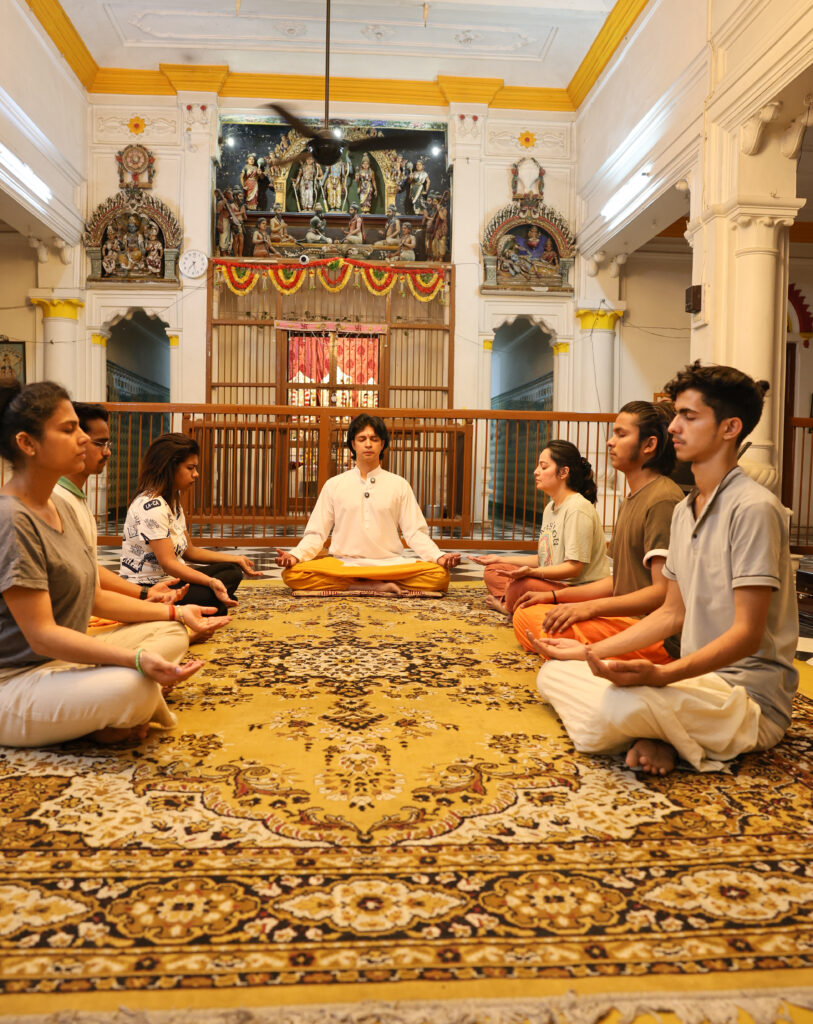
You stay in simple, shared ashram accommodation for the full fourteen days. The emphasis throughout is on sādhana rather than luxury — a quiet, consistent routine that supports the practice rather than competing with it.
A Typical Day
- Early Hatha Yoga and Pranayama
- Morning meditation
- Philosophy and theory sessions
- Self-study, reflection and seva
- Afternoon teaching labs and practice
- Evening meditation and satsang
The Residential Environment
- Reduced phone and digital use
- Periods of Mauna, or silence
- Daily Seva alongside fellow students
- Shared rooms and common facilities
- A routine built around practice, not luxury
- Opportunity to observe yourself outside your usual environment
A meditation teacher’s greatest teaching is not only what they say, but what they embody.
What’s Included
Everything you need for the fourteen days
- 14 days of residential training and supervised practice
- Daily Hatha Yoga and Pranayama sessions
- Guided meditation practice throughout each day
- Study of selected Yoga Sūtra and Bhagavad Gītā teachings
- All vegetarian meals during the residential period
- Shared ashram accommodation
- Teaching methodology sessions and the supervised practicum
- Personal journal and practice materials
- A personal 30-day sādhana plan to take home
- Final assessment and the Foundational Meditation Teacher Certification
What to Expect
An immersive fourteen days
You’ll be invited to wake early, practice daily, participate fully, and step back from unnecessary digital stimulation. There will be periods of silence, self-study, service and — eventually — teaching.
- Early mornings and a full daily schedule
- Full participation in practice, study and seva
- Reduced phone and social media use
- Periods of Mauna, or silence
- Direct feedback during the teaching practicum
- Time set aside for individual reflection
Moments of physical discomfort, restlessness or emotional sensitivity are common in a residential training. They aren’t automatically problems to fix — they’re often the most useful material for Svādhyāya, self-study.
Meals
Food as part of the practice
Meals follow a simple, sattvic-inspired vegetarian approach — prepared to support a full day of practice rather than simply fill time between classes. You’re encouraged to notice what and how you eat, not only what’s on the plate.
- Vegetarian meals included throughout the residential period
- Timed around the daily practice schedule
- Mindful eating is treated as part of the training, not separate from it
Please tell us about any dietary requirements or allergies during the admission process so we can plan accordingly.
What to Bring
Pack simply, come prepared to practice
Bring With You
- Warm layers for early mornings and evenings
- Comfortable clothing for practice and study
- A shawl or meditation blanket
- A notebook and pen for journaling
- A reusable water bottle and personal toiletries
- A mala, if you already use one for Japa
Leave These Behind
- Expensive valuables you don’t need for two weeks
- Excessive clothing or unnecessary electronics
- Large amounts of outside food
- Recreational items that mainly create distraction
- Anything that interferes with the residential discipline
Beyond your bag, bring curiosity, patience and a willingness to observe yourself honestly.
Course Details
What you need to know
Duration
14 Days, Residential
Location
Rishikesh, India
Format
In-Person Residential Intensive
Level
Level 1 — Foundation
Prerequisite
No Meditation Experience Required
Certification
Foundational Meditation Teacher Certification
Language
English, with Hindi Support
Dates
Next batch begins October 3, 2026
Investment
Rs 24,999 (Indian Student), $550 USD (International Student)
Accommodation
Shared Ashram Accommodation, Included
Meals
Vegetarian Meals Included
The Complete Path
Level 1 is the foundation of a three-level journey
Level 1 · This Training
Foundational — 14 Days
Comparable to a 100-Hour training
Each level builds on the one before it — from establishing your own practice, to understanding the deeper workings of the mind, to eventually mentoring other teachers. You do not need to commit to the full path to begin: Level 1 stands complete on its own.
Frequently Asked
Before you apply
Do I need previous meditation experience?
No. The training is designed for complete beginners as well as practitioners who already sit regularly.
Do I need to already be a yoga teacher?
No. Practitioners, yoga teachers, wellness professionals and spiritual seekers all join this training side by side.
How does this compare to a standard hour-based teacher training?
Level 1 is comparable in depth to a 100-hour training. If you’re ready to go further, see the full three-level path — Level 2 goes beyond a standard 200-hour program, and Level 3 beyond a standard 500-hour program.
Will I actually teach during the course?
Yes. A supervised teaching practicum — guiding a full beginner meditation and receiving feedback — is a required part of the training.
What happens after Level 1?
You’re welcome to continue your own daily practice and begin teaching, or progress toward the Advanced and Master certifications when you’re ready.
What language is the course taught in?
English, with Hindi support where needed. Sanskrit terms are introduced with their meaning — no prior knowledge assumed.
What should I pack?
Keep it simple — see What to Bring above for the full list of essentials and what to leave at home.
What if I have dietary requirements or allergies?
Let us know during the admission process — see Meals above — and we’ll advise on what can be accommodated.

Begin Your Journey
Take the first step from practitioner to teacher
Fourteen days in Rishikesh to establish your practice, understand its roots, and learn to guide others — sincerely and safely. Our next batch begins October 3, 2026 — ₹24,999 for Indian students, $550 USD for international students.