
ॐ
Meditation · Beginners
Meditation for Beginners
ध्यान · आरम्भ
A wandering mind is not a failure at meditation — it is the thing you are learning to work with. This course teaches you how, starting from twelve minutes a day.
“You are not trying to stop thinking. You are learning where you are standing.”
The Course
Where this begins
Almost everyone who tries meditation alone gives up in the first fortnight, and almost always for the same reason: they expected a quiet mind, got a noisy one, and concluded they were bad at it. The noise is normal. Learning what to do with it is the entire practice.
Over six weeks we start with the body, move to the breath, and only then to attention itself. You will finish with a practice of your own that takes twelve to twenty minutes and does not depend on being in a special room in a special mood.
This Is For You If
- You have tried an app and it did not stick
- Your mind is busiest at exactly the wrong times
- You want something to do about stress, not just read about it
- You would rather learn from a person than a recording
What You Practise
Six things, learned properly
Sitting well
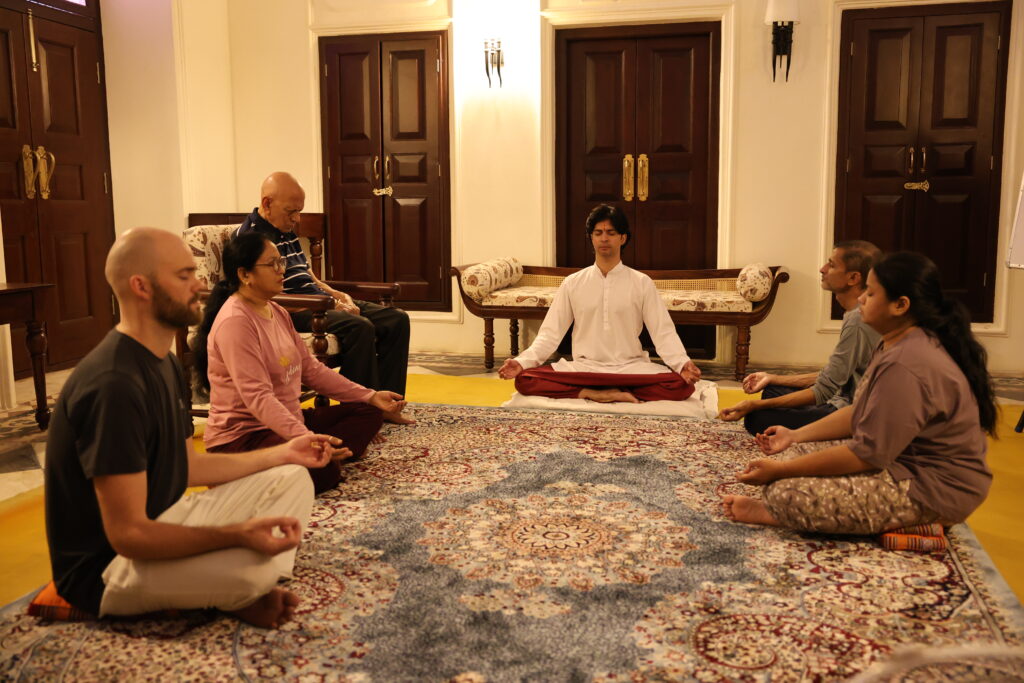
Finding a position — floor, cushion or chair — you can hold without fidgeting or pain.
Body scanning
Attention moved deliberately through the body. The easiest first object, because the body stays put.
Breath awareness
Ānāpāna — watching the breath without steering it, and noticing the moment you start steering.
Working with distraction
What to do when the mind leaves, which is the practical heart of the course.
Mantra and sound
A simple repeated sound as an anchor, for the days when the breath is not enough.
Parasha Kriyā
Our own twelve-minute guided practice, which you can take home and keep.
A Session
How the time is spent
Sessions follow the same shape each week, so that attention goes to the practice rather than to wondering what comes next.
10 min
Settling and posture
10 min
Teaching for the week
20 min
Guided practice
15 min
Questions and what came up
5 min
Setting the week’s home practice
What you need
Before your first session
- No experience, and no particular belief
- Twelve minutes a day at home between sessions
- Clothing loose enough to sit comfortably in
- Cushions, mats and chairs are all provided
- A willingness to be bored occasionally
- Sitting on a chair is entirely acceptable
Questions
Frequently asked questions
I cannot stop my thoughts. Am I doing it wrong?
No. Nobody stops their thoughts, including people who have practised for decades. The skill is noticing that you have wandered and returning without irritation — and each return is the repetition that trains attention.
Do I have to sit cross-legged on the floor?
Not at all. A firm chair with both feet on the ground works perfectly well, and is what we recommend for anyone with knee or hip trouble.
Is this religious?
The techniques come from the yogic tradition and we name their sources honestly, but nothing is asked of your beliefs. People of every faith and none practise here.
Not sure meditation is the right place to start?
That’s a fair question — plenty of people aren’t sure whether meditation, yoga or pranayama is the better first step. Read how to choose your first practice to work out which one fits where you are right now.
How does concentration training actually work?
The classical stage is called Dhāraṇā, and it’s the trainable skill underneath everything that follows. See meditation for beginners, from Dhāraṇā to advanced practice for how the whole path fits together.

When you are ready
Begin where you are
Once a daily sit is established, the advanced course works with longer sittings, dhāraṇā and the stages described in the Yoga Sūtras.