
Most people who say they “can’t meditate” have only ever tried the hardest version first: sit still, close your eyes, stop thinking. That instruction fails almost everyone, not because they lack discipline, but because it skips the actual training. Meditation for beginners isn’t about stopping thought it’s a sequence of skills, and like any skill, it’s learned in an order.
Where the beginner’s path actually starts
Before concentration comes posture and breath — a body that can sit without fighting itself, and a nervous system settled enough to notice something other than its own restlessness. From there, the earliest real skill is simply returning attention to one object, again and again, without judging how many times it wandered. That returning is the entire practice in miniature; everything more advanced is built on being able to do it reliably.
Dhāraṇā: concentration as a trainable skill
Classical yoga calls this stage Dhāraṇā — holding attention on a single point, whether that’s the breath, a mantra, or a fixed image. It sounds simple and is genuinely difficult, which is why it’s taught as a discrete stage rather than assumed. Most meditation frustration traces back to skipping straight to “advanced” instructions — self-enquiry, silence, absorption — without first building a mind that can hold still long enough to attempt them.
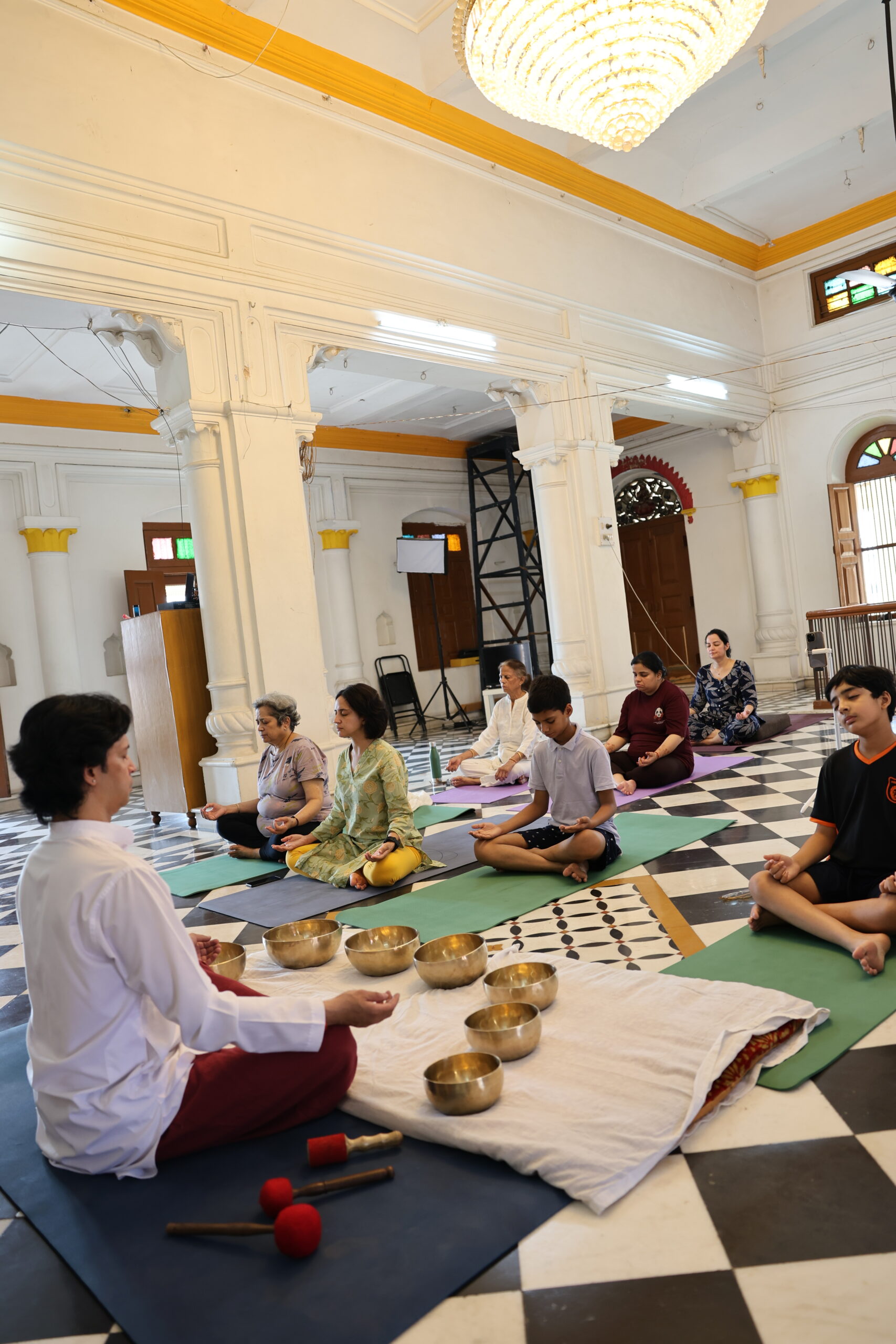
What advanced meditation techniques actually add
Once concentration holds, the practice opens into extended sitting, Trāṭaka (steady, unblinking gaze practice), Antar Mauna (a structured technique for observing the mind’s own chatter without getting pulled into it), and eventually self-enquiry and sūtra study. None of these are gentler versions of what beginners do — they’re what beginner practice was quietly preparing you for. Trying them first, without the foundation, usually just reproduces the same wandering mind in a more advanced-sounding posture.
Why guidance matters more here than in most practices
A teacher watching your practice can tell the difference between productive struggle and a technique that’s simply wrong for where you are — a distinction that’s almost impossible to make about your own mind from the inside. It’s also why deeper work, including anything that touches strong emotion or extended silence, is taught in small groups rather than left to an app or a book.
If you’re starting from zero, our beginner meditation classes teach posture, breath and Dhāraṇā in the order they’re meant to be learned. Once that foundation is steady, advanced meditation continues into Trāṭaka, Antar Mauna and self-enquiry — and for anyone who wants to teach this rather than only practise it, our meditation teacher training covers the tradition in full.